

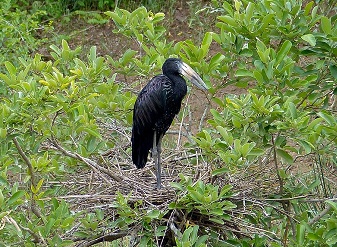
African Openbill in the Serengeti
The African openbill is a dark stork with a unique bill — the upper and lower mandibles do not meet at the tip, leaving a visible gap when the bill is closed. This specialised tool is adapted for extracting aquatic snails and freshwater mussels from their shells, making the openbill one of the most niche feeders among Serengeti wetland birds.
In Serengeti National Park, openbills favour marshes, river backwaters, and flooded grassland where molluscs are abundant after seasonal rains. They are less conspicuous than white spoonbills or hadeda ibises, but equally rewarding for guests who slow down at marsh edges with binoculars ready.
Unlike marabou storks that scavenge at kills, openbills are active hunters of live snails — a fascinating contrast on the same wetland loop that might also produce fish eagles, hamerkops, and darters.
Openbill at a glance
The African openbill is a medium-sized stork — smaller than a marabou, larger than a hadeda ibis. Adults are sooty brown with a greenish gloss on the wings in strong light. The gap in the bill is the single most reliable field mark at any distance where bill detail is visible.
Mandibles do not meet — specialised forceps for snails
Sooty brown with green gloss in good light
Flooded grass and quiet river backwaters
Often standing motionless in ankle-deep water
How to identify an African openbill
Look for a dark, medium-sized stork with long grey legs and a grey bill showing a clear gap between the mandibles when closed. In flight, the neck is extended and wings show pale inner panels against darker flight feathers. Openbills fly with slow, steady wingbeats — less laboured than marabou storks.
Do not confuse with immature yellow-billed stork (paler, yellow bill, no gap) or woolly-necked stork where ranges overlap. On the ground, the feeding posture — head lowered, bill probing mud — combined with the gap bill confirms the species.
Compare with the African spoonbill (all-white, flat spoon bill) and the hadeda ibis (grey-brown ibis, loud dawn call) at the same wetland.
Three steps to spot an openbill in Serengeti
Scan any dark stork at a wetland — if the mandibles do not meet at the tip, you have an openbill. This is unique among storks in the park.
Focus on flooded grass and backwaters away from fast main river channels. Openbills avoid deep water and strong current.
Check groups of spoonbills, egrets, and ibises — openbills often feed in the same shallow pan but stand apart, motionless.
Snail feeding in Serengeti wetlands
Openbills wade slowly through shallow marsh, probing mud and submerged vegetation for aquatic snails. The gap in the bill acts like forceps — the bird inserts the lower mandible into the shell aperture and uses the upper mandible to cut the muscle that anchors the mollusc. This feeding technique is highly specialised and explains why openbills are tied to snail-rich habitats.
They breed colonially in some parts of Africa, building stick nests in riverside trees. In Serengeti they are more often seen in small groups or pairs. After rains, flooded grassland near Seronera and the western corridor can hold concentrations that are absent in the dry season.
Compare feeding styles with the African spoonbill guide (sweep-feeding fish and invertebrates), nest architecture with the hamerkop guide, and diving hunters with the African darter guide on the same wetland drive.
When to see openbills in Serengeti
Openbills are present year-round but are most numerous after the long rains (April–May) and short rains (November) when flooded grassland creates ideal snail habitat. During dry months they concentrate at permanent pools, river backwaters, and the margins of shrinking pans.
Plan wetland birding as part of a broader Northern Circuit route — browse the Serengeti wildlife gallery and read our Serengeti wildlife guide for seasonal timing on the Northern Circuit.
Where openbills feed in Serengeti
Flooded grassland near Seronera and western corridor concentrates snails — openbills follow within days.
Quiet side channels off the Mara and Grumeti rivers hold openbills year-round.
Pause at every river bridge — scan both banks and shallow margins before moving on.
Seasonal pools near Seronera, Ndutu in the wet season, and the Grumeti river system are reliable zones. Openbills share these habitats with spoonbills, egrets, and storks — a single stop can add five wader species to your day list.
Safari tips for openbill sightings
Openbills stand motionless for long periods — patience at marsh edges pays off.
Schedule wetland stops in the week after heavy rain for peak numbers.
A mid-range zoom captures the gap bill — the key ID feature for your trip list.
Ask your guide to pause at marsh edges even when big game is the priority — openbills reward slow wetland birding. Book a 7-day Northern Circuit safari with river and pool time in Serengeti National Park.
Plan a wetland birding safari in Serengeti
From openbills and spoonbills to fish eagles and darters, we weave wetland stops into every private Northern Circuit route from Arusha — paced for birding and big game on the same day.
