

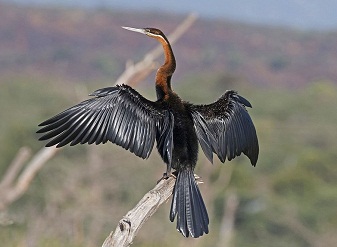
African Darter in the Serengeti
The African darter — also called the snakebird — is a long-necked waterbird that hunts fish by swimming underwater and spearing prey with its sharp bill. After diving, it perches with wings spread wide to dry, revealing striking black-and-white plumage.
In Serengeti, darters are found on slow rivers, pools, and permanent waterholes. Their sinuous neck and dagger bill make them unmistakable when drying on a riverside branch or gliding low over the water.
Bridge stops on the Mara and Grumeti are reliable stakeouts — scan dead snags before open water, because darters often perch motionless with wings spread between dives.
Underwater hunt
Swims submerged to spear fish
Wing drying
Spreads wings on riverside perches
Snake neck
Long S-shaped neck in profile
River pools
Mara, Grumeti, Seronera
How to identify an African darter
Slim waterbird with a long thin neck, pointed yellow bill, and dark body with white wing stripes. Often seen perched with wings fully extended to dry — a posture shared with cormorants but with a longer, more serpentine neck.
In flight, neck is held straight or slightly kinked; wings beat steadily and low over water. Juveniles are browner overall. Compare river hunters with the African fish eagle guide and waders with the spoonbill guide.
Index every species on the wildlife gallery and plan routes with the Serengeti wildlife guide on the Northern Circuit.
Diving and drying behaviour
Darters swim with only the neck above water, then dive smoothly below the surface. They pursue fish underwater and impale them on the bill before surfacing to swallow. Because their plumage is less waterproof than a duck’s, they must dry wings frequently — look for spread-wing perches on dead trees over water.
Pair darter watching with the African openbill guide on the same wetland loop — both favour quiet backwaters but hunt very differently.
Early morning is best for wing-drying displays when the bird is backlit and motionless on a perch.
Why darters are called snakebirds
Only the sinuous neck is visible when swimming — the body rides low underwater, creating a snake-like silhouette. The neck has extra vertebrae for striking accuracy underwater. Spread-wing drying is essential because darter feathers absorb water, reducing buoyancy during dives.
On Serengeti river drives, scan dead branches and drowned tree trunks — darters use these as drying platforms between dives.
Pair darter stops with fish eagles and spoonbills on the same Mara or Grumeti morning — our wildlife gallery lists every wetland species for the Northern Circuit.
Safari tips for darter sightings
Scan drowned trees and snags over slow water.
Best photos when wings are fully extended to dry.
Morning backlit perches give the strongest silhouettes.
Book a 7-day Northern Circuit safari with river birding in Serengeti National Park.
Bridge stops on the Mara and Grumeti are reliable darter stakeouts — scan dead snags before scanning open water.
Darters swim low with only the neck above water — combine with fish eagles and spoonbills for a full wetland morning on the Northern Circuit.
Plan a river birding safari in Serengeti
From darters to fish eagles, we build private wetland routes with realistic river stops across the Northern Circuit.
Ask for bridge crossings and camp nights on the Grumeti or Mara when river birds are a priority on your Serengeti safari.
Spread-wing drying displays are best in early light — we build river time into the first hour of drives when darters and fish eagles are most active along the banks.
