

Grey-headed Kingfisher in the Serengeti
The grey-headed kingfisher is a medium-sized woodland kingfisher with a grey head, chestnut belly, and bright blue wings and rump. Unlike many kingfishers, it hunts away from open water — taking insects, lizards, and small vertebrates from perches in acacia and riverine trees.
In Serengeti, grey-headed kingfishers are found along the Mara, Grumeti, and seasonal drainage lines where trees overhang quiet water or bare branches provide hunting posts. Their sharp call carries along river corridors and is often the first clue to their presence.
They are one of three kingfisher species visitors may record on a Serengeti bird list — alongside the smaller striped kingfisher and the giant pied kingfisher on larger rivers. Guests often spot their first grey-headed kingfisher at a bridge crossing when turquoise wings flash against acacia woodland.
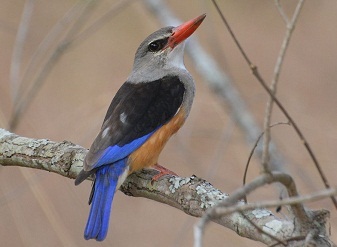
Perch-and-pounce hunting
Grey-headed kingfishers are sit-and-wait predators. They select an exposed branch, wire, or stump with a clear view of the ground below, then drop onto prey with a direct flight. Fish are taken occasionally, but insects, grasshoppers, lizards, and frogs are the main diet in Serengeti.
Overhanging branches on Mara and Grumeti crossings.
Grasshoppers and beetles — not dependent on fish.
Blue wings flash when the bird flies between perches.
How to identify a grey-headed kingfisher
Grey head and breast, rich chestnut belly, and vivid azure wings and rump. Bill is bright red-orange; legs red. In flight, the blue rump and wing panels are striking against acacia woodland. Size is between striped kingfisher (smaller) and woodland kingfishers of other regions.
Do not confuse with woodland kingfisher where ranges overlap — grey-headed has a grey (not blue) head. Compare with our striped kingfisher guide for the smaller species on the same river route.
Pair river kingfisher stops with the African fish eagle guide and hamerkop guide for a full wetland morning.
Along Serengeti river corridors
Grey-headed kingfishers nest in tree cavities and earth banks along rivers. They are territorial around favoured perches and may chase intruders with loud chattering calls. On game drives, pause at every bridge and sandbar — kingfishers often sit on exposed dead branches at eye level.
Morning light on the Mara and Grumeti gives the best photography when birds are backlit on riverside perches. They are less shy than many woodland species and may allow approach in a stationary vehicle.
Index every species on the wildlife gallery and plan routes with the Serengeti wildlife guide on the Northern Circuit.
Listen for the sharp whistle
The grey-headed kingfisher call is a loud, descending whistle followed by a chatter — often given in flight between perches. Learning this call helps you spot birds hidden in riverside foliage before they fly to an open branch.
Pairs are vocal at dawn when establishing territory along a river stretch. If you hear the whistle but cannot see the bird, scan low branches on both banks — kingfishers often move between perches in short flights just above the water.
Browse the Serengeti wildlife gallery for all kingfisher and river species on your route.
Where to see grey-headed kingfishers
Bridge stops and sandbars — scan dead branches at water level
Western Serengeti riverine belts hold pairs year-round
Acacia overhanging seasonal drainage lines near Seronera
Kingfishers are resident — they do not migrate, so any river drive offers a chance. Combine with crocodile and hippo watching at the same stops for a rich waterhole pause.
Safari tips for kingfisher sightings
Two minutes at every river crossing — kingfishers use low perches.
First two hours along east-facing riverbanks for best colour.
Whistle alerts you before the bird flies to an open perch.
Book a 7-day Northern Circuit safari with river time in Serengeti National Park.
Plan a river birding safari in Serengeti
From kingfishers to fish eagles, we build private wetland routes with realistic river stops across the Northern Circuit.
