

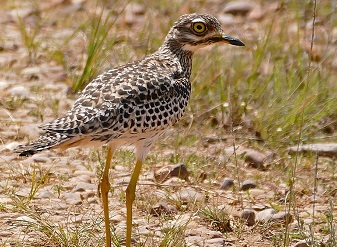
Spotted Thick-knee in the Serengeti
The spotted thick-knee is a cryptic, ground-dwelling bird of open plains and bare ground — superbly camouflaged by buff and brown speckled plumage that melts into dry soil and short grass. Large yellow eyes and thick yellow legs give it a distinctive profile when seen well.
In Serengeti, thick-knees are most active at dusk and dawn, foraging for insects and small vertebrates on firebreaks, airstrips, and open ground near water. By day they often stand motionless in shade or lie flat on the ground — easy to drive past without noticing.
They share open-country habits with coqui francolins and rufous-naped larks, but thick-knees are strictly crepuscular — the best sightings come at last light when they emerge to feed in the open.
Spotted thick-knee at a glance
A medium-sized ground bird with mottled buff-brown plumage, large pale eyes, and thick yellow legs. The name refers to the swollen knee joints visible when walking. In flight, broad wings show bold black-and-white wing bars.
Most active at dusk and dawn
Adapted for low-light hunting
Melts into bare ground and dry grass
Beetles, termites, small vertebrates
How to identify a spotted thick-knee
Look for a stocky ground bird with speckled brown upperparts, pale underparts, and a bold black-and-white facial pattern. Bill is short and stout; legs are long and yellow. When alarmed, thick-knees freeze or run rather than fly — flight is direct with conspicuous wing bars.
At distance, the horizontal posture and large eyes are the best clues. Do not confuse with coursers or plovers — thick-knees are bulkier with heavier legs and a thicker bill. On night drives, eye-shine from spotlighting often reveals birds invisible in daylight.
Pair dusk thick-knee searches with grassland birds on our wildlife gallery and Serengeti wildlife guide.
Three steps to spot a thick-knee at dusk
Start scanning 30 minutes before sunset on open ground.
Firebreaks, airstrips, and pan edges — not tall grass.
Freeze when spotted — birds rely on camouflage and may hold.
Nocturnal habits on the plains
Spotted thick-knees are adapted to hunting in low light. Their large eyes gather more light than diurnal birds, and they forage actively at dusk when insects emerge and temperatures cool. They walk deliberately, pausing to seize prey with the bill.
By day, thick-knees shelter in shade or lie flat on open ground — their plumage matches dry soil so closely that only movement gives them away. A stationary vehicle at dusk often allows close views as birds emerge to feed.
Plan routes on the Northern Circuit with at least one late-afternoon drive across open country.
Why dusk drives reward thick-knee watchers
Thick-knees are one of the best reasons to extend a game drive past sunset. As diurnal mammals settle and nocturnal species emerge, thick-knees walk openly across firebreaks and camp perimeters — behaviour rarely seen at midday.
Book a 7-day Northern Circuit safari with flexible timing in Serengeti National Park so your guide can plan at least one dusk session on open ground.
Where to see spotted thick-knees in Serengeti
Bare strips beside main tracks — classic thick-knee habitat
Seronera and bush airstrips hold pairs at dusk
Open ground around lodges — scan before dinner
Thick-knees are resident year-round. Dry season concentrates birds on remaining bare ground; green season spreads them across short-grass plains after rains. Night drives where permitted may also produce thick-knees by spotlight. Ask your guide to pause on any open firebreak at last light — this is one of the most reliable ways to add thick-knee to a Serengeti bird list.
Safari tips for thick-knee sightings
Stay out 30–45 minutes after sunset on open ground.
Look for horizontal shapes on firebreaks and pan edges.
Stop the vehicle — thick-knees may freeze in place.
Combine dusk birding with coqui francolin dawn calls for a full grassland bird list.
Plan a dusk birding safari in Serengeti
From spotted thick-knees to francolins and larks, we build private routes with dawn and dusk timing built into every Northern Circuit day.
