

Southern Masked Weaver in the Serengeti
The southern masked weaver is a small, bright yellow bird of acacia woodland — famous for the male’s elaborate woven nests that hang from thorn branches over water or open ground. Breeding males wear a black face mask and chestnut crown; females and non-breeding males are streaky yellow-green.
In Serengeti, weaver colonies appear in acacia belts, lodge gardens, and riverine woodland during the rainy season. Males build multiple nests to attract females, destroying rejected structures and starting again — one of the most entertaining bird behaviours on a safari.
Weavers share acacia habitat with superb starlings and speckled mousebirds — scan the same trees for three species on one stop.
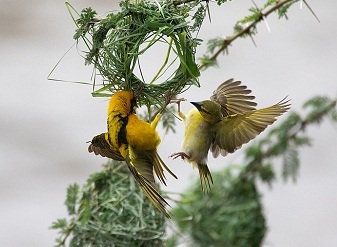
Masked weaver at a glance
Males build hanging grass nests in colonies
Black face mask and chestnut crown
Riverine woodland and lodge gardens
Colonies peak when grass for weaving is green
How to identify a southern masked weaver
Breeding males are bright yellow with a black face mask extending onto the throat, chestnut crown, and olive back. Females and non-breeding males are duller yellow-green with streaked underparts. Bill is conical and pale; legs are pinkish.
The hanging woven nest is the best field mark — a ball of grass strips with a downward-facing entrance tube, suspended from an acacia branch. Colonies may contain dozens of nests in a single tree, with males displaying and calling from nearby perches.
Do not confuse with village or lesser masked weavers where ranges overlap — southern masked males have a fuller black mask and chestnut (not black) crown. See our superb starling guide for another common yellow bird in the same habitat.
Three steps to find weaver colonies
Look for hanging grass balls over water or open ground.
Colonies are noisy — males call and display at nests.
Breeding peaks when fresh grass is available for weaving.
Nest building and colony life
Male southern masked weavers are prolific builders. A single male may construct ten or more nests in a season, each woven from strips of green grass pulled from nearby stems. Females inspect nests and may reject poorly built structures — males tear down rejected nests and begin again.
Colonies form in acacia trees overhanging water or bare ground — the open space below may reduce predator access. Watching a colony at work is one of the best birding experiences in Serengeti camps during the green season.
Index every species on the wildlife gallery and read the Serengeti wildlife guide for seasonal birding on the Northern Circuit.
Best season for weaver colonies
Southern masked weavers breed during and after the long rains when green grass is abundant for nest weaving. Colonies appear from November through April across Serengeti acacia belts — lodge gardens and camp perimeters often hold the most accessible colonies for photography.
Plan a 7-day Northern Circuit safari in green season for weaver colonies alongside wildebeest calving on the southern plains.
Where to see masked weavers in Serengeti
Fruit trees and acacias at camp — colonies at eye level.
Mara and Grumeti belts — nests overhanging water.
Seronera and western corridor acacia thickets.
Weavers are diurnal and active all day during breeding — morning light on east-facing colonies gives the best photography. Non-breeding birds remain in flocks year-round but are less conspicuous without nests. A single acacia tree may hold twenty or more woven nests in peak season — one of the most photogenic bird spectacles on a green-season safari.
Safari tips for weaver sightings
Ask your guide to pause at acacia colonies during green season — nest building is fast and fascinating. See our superb starling guide for more camp birds. Book a 7-day Northern Circuit safari in Serengeti National Park.
Plan a green-season birding safari in Serengeti
From weaver colonies to starlings and mousebirds, we weave acacia woodland birding into every private Northern Circuit route from Arusha.
