

Leopards in the Serengeti
The Serengeti leopard is the most elusive of the Big Five — a solitary cat built for ambush, camouflage, and life in the branches. Unlike lions that dominate open plains in prides, leopards work alone, hauling kills into acacia and sausage trees where hyenas and lions cannot reach them.
A leopard draped over a horizontal limb at dusk is one of Africa’s iconic safari images. Sightings are never guaranteed, but Serengeti holds one of the continent’s healthiest leopard populations when you know which river lines, kopje margins, and gallery forests to search.
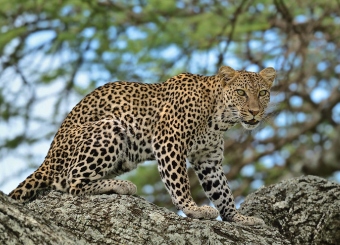
Adults defend overlapping territories and hunt alone at night.
Often rests and feeds in acacia, sausage, and fig trees.
Peak movement when impala and dik-dik are most active.
How to identify a Serengeti leopard
Leopards are compact, muscular cats with a golden coat covered in black rosettes — solid spots on the head, legs, and tail. Males are noticeably larger than females; both carry a long, thick tail used for balance in trees and as a counterweight during explosive sprints on the ground.
At distance, do not confuse with cheetah (slimmer build, teardrop facial marks, solid spots not rosettes) or young lions (uniform tawny coat, no rosettes). Servals are much smaller with large ears and bold spotting on long legs — common in grassland but a different silhouette entirely.
The classic tree-rest posture — legs dangling, tail hanging — is diagnostic. On the ground, leopards walk with a low, fluid gait and often pause on termite mounds or fallen logs to scan. Compare the open-plains hunter in our Serengeti lion guide and browse every Big Five species on the wildlife gallery.
For seasonal context across mammals and birds, read the full Serengeti wildlife guide before you travel.
Leopard behavior on game drives
Leopards are crepuscular and nocturnal hunters. Morning drives along river lines often find cats finishing a night hunt or descending from a kill tree. Midday heat pushes them into deep shade — under rocky overhangs, dense riverine thickets, or high in leafy branches where only a tail tip or spotted flank may be visible.
Impala are the staple prey in Serengeti, but leopards also take Thomson’s gazelle, warthog piglets, and birds. After a kill, a leopard may spend two or three days feeding in the same tree, descending only at night. Spotted hyenas and lions will steal ground kills; arboreal feeding is the leopard’s evolutionary answer to stronger competitors.
During the Great Migration, leopards along the Mara and Grumeti river corridors intercept weakened or separated animals near crossing points. Timing follows herd movements — see our Serengeti migration month-by-month guide for when columns concentrate in the north versus the southern calving plains.
Lions dominate the same landscapes but hunt differently — read our Serengeti lion guide to understand pride dynamics on the Northern Circuit.
Where to see leopards in Serengeti National Park
Leopards need cover, prey, and climbable trees. Tell your guide you want cat-focused routing along river lines and kopje margins rather than only scanning open plains. Patient, quiet drives at first and last light deliver the best odds.
Every Big Five species is indexed on our Serengeti wildlife gallery. For park logistics, camp zones, and drive times, see Serengeti National Park on the Northern Circuit.
Central Serengeti gallery forest and acacia corridors — reliable year-round leopard territories.
Rocky outcrops in the northeast hold shade-loving cats and impala herds at plain edges.
Riverine woodland near Kogatende — leopards shadow migration herds July to October.
Grumeti woodlands and glades — quieter roads, skilled scanning at dawn along drainage lines.
Safari tips for leopard sightings
Check every horizontal branch along rivers — leopards melt into dappled shade until you look twice.
Switch off music near cats; slamming doors or raised voices make leopards slip away into thick cover.
The final hour before park gate closing often delivers movement along drainage lines and kopje bases.
Book two full days in Serengeti on a 7-day Northern Circuit safari with a guide who knows cat territories. Pair leopard drives with migration timing from our month-by-month migration guide and the open-plains pride behavior in our Serengeti lion guide.
Plan a Serengeti safari focused on leopards
We tailor private routes from Arusha with cat-friendly guides, river-line camp zones, and realistic drive times for your travel month — so you maximize dawn and dusk windows when leopards are most active.
